Special Hazards Fire Suppression Systems
Standard sprinklers aren't enough when the assets you're protecting can't tolerate water — or when the fire risk involves flammable liquids, energized electronics, or processes that demand zero downtime. A water discharge in a data center, an archive, or a chemical processing room can cause more damage than the fire itself.
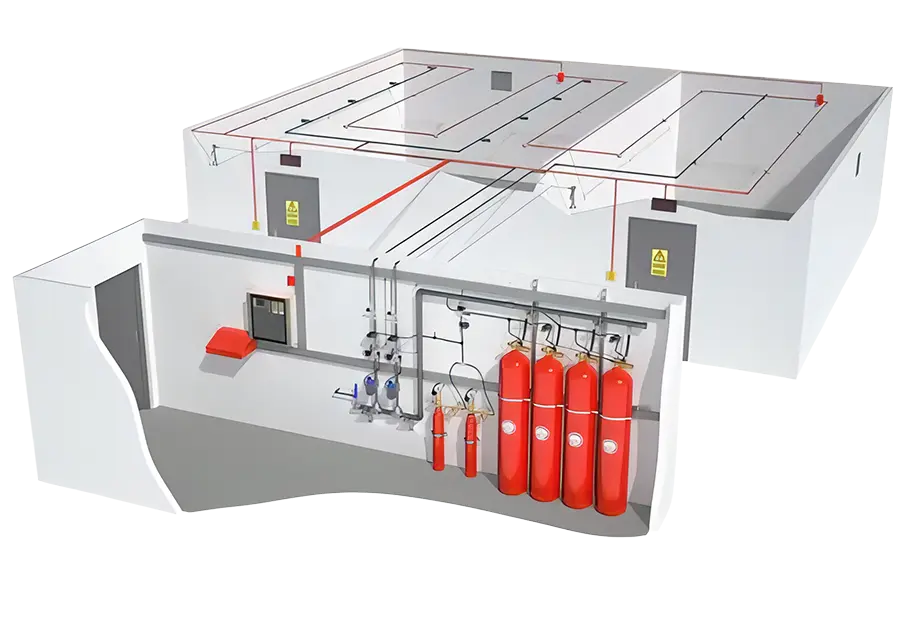
Special hazards systems are engineered for exactly these environments. Custom-designed clean agent, gas, foam, water mist, and dry chemical solutions detect fires within seconds and suppress them at the source — without ruining the equipment, processes, or assets you're trying to save.
Our Special Hazards Suppression Systems
We design, install, inspect, and service the full range of engineered special hazards systems:
Clean Agent Fire Suppression
Inert Gas Fire Suppression
CO2 Fire Suppression
Water Mist Fire Suppression
Foam Fire Suppression
Dry Chemical Fire Suppression
Additional Special Hazards Services
Beyond engineered suppression systems, we provide the detection, communication, and lifecycle services that keep special hazards programs compliant and operational.
Advanced Fire Detection & Control
ERRCS / BDA In-Building Coverage
Recharge
Design and Engineering
What Are Special Hazards Fire Suppression Systems?
Special hazards systems are engineered fire protection solutions designed for environments where standard water-based sprinklers may cause damage or simply aren't effective. Each system is purpose-built around the specific fire risks, contents, and operational requirements of the protected space.
These systems are used to protect:
- Sensitive electronics, server rooms, and data infrastructure
- Flammable liquid storage, processing equipment, and chemical plants
- High-value machinery, turbines, and generators
- Critical operations where downtime translates to massive financial loss
- Irreplaceable assets like archives, museum collections, and artwork
- Telecommunications, control rooms, and command centers
Every system is custom-engineered to meet NFPA standards, FM Global requirements, manufacturer specifications, and local fire codes.
Key Benefits of Special Hazards Systems
Because every protected environment is unique, our systems are engineered to match — not just installed from a catalog. Some of the core benefits:
- Rapid suppression — fires controlled in seconds, often before sprinklers would even activate
- Protection for sensitive equipment — non-conductive, residue-free agents that won't damage electronics
- Minimal residue and cleanup — most clean agents leave no residue, allowing operations to resume quickly
- Enhanced personnel safety — gas and clean agent systems can be used in occupied spaces with proper engineering
- Reduced downtime — assets remain operational after discharge, unlike water-damaged equipment
- Intelligent detection and control — engineered detection systems verify fire conditions before discharge
- Non-conductive agents — safe for use around energized electrical equipment
- Non-corrosive options — agents that don't damage metal, electronics, or precision equipment
- Versatile applications — single facility may use multiple system types for different hazard zones
- Flexible foam options — high, mid, and low-expansion foam configurations for different liquid hazards
Industries We Protect
Engineered fire suppression matters most in industries where downtime, water damage, or asset loss carries an outsized cost:
- Data centers and IT infrastructure — server rooms, switch gear, telecom closets, hyperscale facilities
- Power generation — gas turbines, generators, control rooms, switchyards
- Mining operations — surface and underground, mobile equipment, conveyor systems
- Manufacturing and industrial processing — chemical plants, paint booths, dust collection systems
- Telecommunications — central offices, network operations centers, cell sites
- Healthcare and medical imaging — MRI rooms, server rooms, diagnostic equipment
- Aerospace and defense — hangars, simulators, weapons storage, command centers
- Museums, archives, and cultural institutions — irreplaceable collections, rare book libraries
- Automated warehouses and logistics centers — high-bay storage, robotic systems
- Marine and offshore — engine rooms, machinery spaces, control rooms
- Oil and gas — refineries, processing facilities, fuel storage, drilling operations
Full Lifecycle Special Hazards Services
We support every phase of a special hazards system, from initial hazard analysis through decades of service life:
- System design and engineering — custom layouts, hydraulic calculations, and code compliance review
- Installation and commissioning — certified installation with full discharge testing and AHJ acceptance
- Inspection and testing — NFPA-compliant inspection schedules (NFPA 2001, NFPA 12, NFPA 11, NFPA 17, NFPA 750)
- Preventive maintenance — scheduled service to prevent component failure and missed discharges
- System upgrades and retrofits — agent transitions (Halon replacement, FM-200 to Novec, etc.) and detection upgrades
- Emergency service and repairs — 24/7 response for system troubles, post-discharge service, and code-deficiency corrections
Every service is delivered by certified technicians and documented for AHJ inspections, insurance audits, and internal compliance programs.
Re-Charge Services
A discharged suppression system is an unprotected facility. Re-charge services restore special hazards systems to peak performance after activation or scheduled maintenance — quickly, completely, and to manufacturer specification.
Why our re-charge services stand out:
Certified Technicians
Every re-charge follows NFPA standards and manufacturer guidelines
Fast Turnaround
Efficient service to minimize the time your facility runs unprotected
Quality Assurance
Only approved agents and OEM-specified components used
Compliance Documentation
Full paperwork provided for AHJ, insurance, and corporate compliance records
We re-charge clean agent cylinders, CO2 systems, foam systems, dry chemical systems, and water mist storage — across every major manufacturer.
Design & Engineering Services
Every facility is unique, and so are its fire protection needs. Custom design and engineering services deliver fire suppression solutions matched to your operational requirements, hazard profile, and regulatory environment.
Our engineering expertise covers:
Hazard and Risk Analysis
Identifying fire risks across processes, equipment, and contents to determine the right protection strategy
System Design and Layout
Engineered drawings, hydraulic and pneumatic calculations, agent quantity calculations, and nozzle placement
Integration
Seamless connection with fire alarm, BMS, HVAC shutdown, and emergency power systems
Code Compliance
Designs meet NFPA, FM Global, UL, and local AHJ standards
AHJ submittal and approval
Permit packages and on-site review support
Commissioning
Final acceptance testing, discharge testing, and complete documentation
Why Choose State Fire for Special Hazards
- Certified special hazards technicians with deep field experience
- Multi-system expertise across clean agent, gas, foam, water mist, dry chemical, and detection systems
- In-house engineering for custom-designed solutions
- Authorized installer for major manufacturers including Fike, Janus Fire Systems, Kidde, and Ansul
- NFPA, FM Global, and UL-compliant design and installation
- 24/7 emergency service for system troubles and post-discharge response
- Full lifecycle support: design, install, inspect, recharge, repair
- Integrated with broader fire and life safety services for unified building protection
Special Hazards Services Near You
Engineered fire suppression services are delivered from regional offices with technicians trained on every system type covered above.

Special Hazards FAQs
What is a special hazards fire suppression system?
A special hazards fire suppression system is an engineered fire protection solution designed for environments where traditional water-based sprinklers aren't effective or could cause damage. These systems use specialized agents — clean gases, CO2, foam, water mist, or dry chemical — to suppress fires quickly without harming sensitive equipment, electronics, or operations.
Where are special hazards systems commonly used?
Special hazards systems are typically installed in data centers, server rooms, industrial facilities, power generation plants, telecommunications rooms, hospitals, museums, archives, aerospace facilities, mining operations, and manufacturing environments where downtime or water damage would carry significant financial or operational impact.
What's the difference between clean agent and CO2 systems?
Clean agent systems (FM-200, Novec 1230, FK-5-1-12) extinguish fires without leaving residue and are safe for occupied spaces at design concentrations. CO2 systems are typically used in unoccupied or restricted-access areas because CO2 displaces oxygen to suppress fire and is lethal at design concentrations.
Are special hazards fire suppression systems required by code?
In many industries, yes. NFPA standards, insurance carriers, and AHJs frequently require engineered special hazards systems in high-value or sensitive environments where water-based suppression would be ineffective or destructive. Data centers, telecommunications facilities, and industrial process areas commonly have code-driven requirements.
How fast do special hazards systems activate?
Most engineered special hazards systems activate within seconds of fire detection — often before flames are visible — providing rapid suppression that minimizes equipment damage and operational downtime. Detection and discharge sequencing is engineered around each protected environment.
Do these systems require ongoing maintenance?
Yes. NFPA standards require regular inspection, testing, and maintenance to ensure system readiness. Specific schedules vary by system type and standard — NFPA 2001 for clean agents, NFPA 12 for CO2, NFPA 11 for foam, NFPA 17 for dry chemical, and NFPA 750 for water mist — but most components require at least annual inspection.
Can special hazards systems integrate with existing fire alarms?
Yes. Engineered special hazards systems are designed to integrate with fire alarm and building management systems for coordinated detection, pre-discharge warnings, automatic shutdowns, and unified emergency response.
What's involved in replacing or upgrading a Halon system?
Halon production was banned under the Montreal Protocol, and many legacy Halon 1301 systems are being replaced with modern clean agents like FM-200, Novec 1230, or inert gases. State Fire performs Halon decommissioning, agent replacement, and full system retrofit including detection and control panel upgrades.